B.Sc Fire and Safety Course Details: Scope, Fees, Career & Salary
B.Sc Fire Safety: Choosing a post-12th or post-graduation career choice is no longer about possessing a degree but it is about employability, long term security and industry relevance. In the past 10 years, Fire and Safety is one of the spheres, which has commonly expanded in terms of industries, geography, and economic cycles.
Manufacturing plants, construction projects, hospitals, airports, power plants, and government infrastructure are not an optional addition to the list of places where fire and safety professionals are undertaken. This fact has rendered B.Sc in Fire and Safety one of the surest and future-retaliated degree programs to the students seeking certainty and regard in their employment.
This guide makes everything clear and easy to understand- according to industry standards, regulations, and actual career paths, so that you can make a definite and confident decision.
- Legal Requirement, Not a Trend
- B.Sc Fire and Safety Course Details
- Subjects Covered in B.Sc in Fire and Safety
- B.Sc Fire and Safety Course Qualification (Eligibility)
- Bsc Fire And Safety Course Fees
- Scope of Fire and Safety Course
- Career Options After B.Sc in Fire and Safety
- Bsc fire and safety course salary After Completion
- How to Become a Fire Safety Officer?
What is B.Sc. in Fire and Safety?
The bsc in fire and Safety is a profession undergraduate degree course that equips students with the ability to manage, prevent and control fire and safety hazards in industrial, commercial and public settings.
As opposed to general science degrees, the program is practical. It emphasizes the implementation of safety in workplaces, in reality in terms of systems, audits, laws, engineering controls and emergency response planning.
Such qualification is most often searched by students with terms like:
- B.Sc Fire Safety
- B.Sc Fire and Safety
- Fire Degree
- Fire Safety Management
- Fire Safety Engineering (foundation level)
Each of them is connected with the same professional field occupational fire and safety management.

Why Fire and Safety is a Critical Profession Today
Legal Requirement, Not a Trend
The Indian industries have strict safety laws including the Factories Act, construction safety regulations as well as the industrial safety regulations. These legislations require a qualified safety officer to be appointed.
This implies that the organizations need to employ trained fire and safety personnel to conduct business within legal boundaries.
Industry Growth Across Sectors
Fire and safety professionals are used in:
- Manufacturing & heavy industries.
- Construction projects and infrastructure projects.
- Oil & gas and power plants
- Airports, metros, and ports
- Hotels, malls, hospitals and IT parks.
The number of safety positions grows with the growth in infrastructure.
Career Stability
Fire and safety work is ground-based and responsibility-driven unlike most desk-based jobs. Automation and AI can never substitute it, placing it in the long-term, time-stable occupation.
B.Sc Fire and Safety Course Details
Degree Structure
- Name of course: B.Sc in Fire and Safety.
- Bsc Fire and safety course duration is 4 Years (Honours Program)
Mode of Learning
- Online academic support / distance.
- Theoretical classes online.
- Formal self-education aided.
Examination
- University-conducted examinations
- Students take examinations in a specified university exam center.
This model will enable students to study in their home cities and receive a university degree of recognized standard.

Subjects Covered in B.Sc in Fire and Safety
The program is implemented in such a way that it is realistic to actual industrial tasks, rather than knowledge on textbooks.
Core Academic Areas
- Essentials of Fire Science.
- Fire Prevention and Fire protection systems.
- Safety Management in the Industry.
- Occupational Health & Safety
- Hazard Identification and Risk Assessment (HIRA)
- Disaster Management
- Safety Legislation and Compliance.
Practical & Applied Concepts
- Fire safety audits
- Emergency response planning.
- Accident investigation
- Safety in construction and industry.
- The basics of fire safety engineering.
This mix will make the graduates knowledgeable of the technical and managerial aspects of safety.
B.Sc Fire and Safety Course Qualification (Eligibility)
Students can be eligible provided that they have:
- Completed 10+2 in any recognized board (any stream).
- OR degree or other equivalent diploma.
- Other disciplines can also apply graduates.
There is no background of fire or safety. The program begins with basic notions and develops.
Bsc Fire And Safety Course Fees
The primary issue that most students and families have is cost.
B.Sc Fire and Safety Course Fees From YCMOU
- ₹30,000 per semester
This arrangement is better than full-time colleges that are privately owned:
- Lowers the total education expense.
- Eliminates hostel and relocation costs.
- Enables finance management among students.
This renders the degree very cost-effective in terms of career-planning.

Fire Safety Management vs Fire Safety Engineering
These two areas are normally confused among the students.
Fire Safety Management
Focuses on:
- Occupational health and safety systems and procedures.
- Compliance with laws
- Safety inspections and reports.
- Supervisory and managerial duties.
Fire Safety Engineering
Focuses on:
- Fire protection and extinguishing equipment.
- Engineering controls
- Design of technical fire protection.
B.Sc in Fire and Safety offers exposure to both so that the graduates can advance in either of those positions through experience and industry requirements.
Scope of Fire and Safety Course
Fire and safety management is a wide field that keeps on increasing.
Employment Sectors
- Manufacturing plants and industries.
- Real estate and construction.
- Power plants and refineries
- Metro projects, airports and ports.
- Hospitals/ hospitality industry.
- Fire and emergency services of the government.
Safety does not belong to a single industry, it is needed all over when people and properties are at work.
Career Options After B.Sc in Fire and Safety
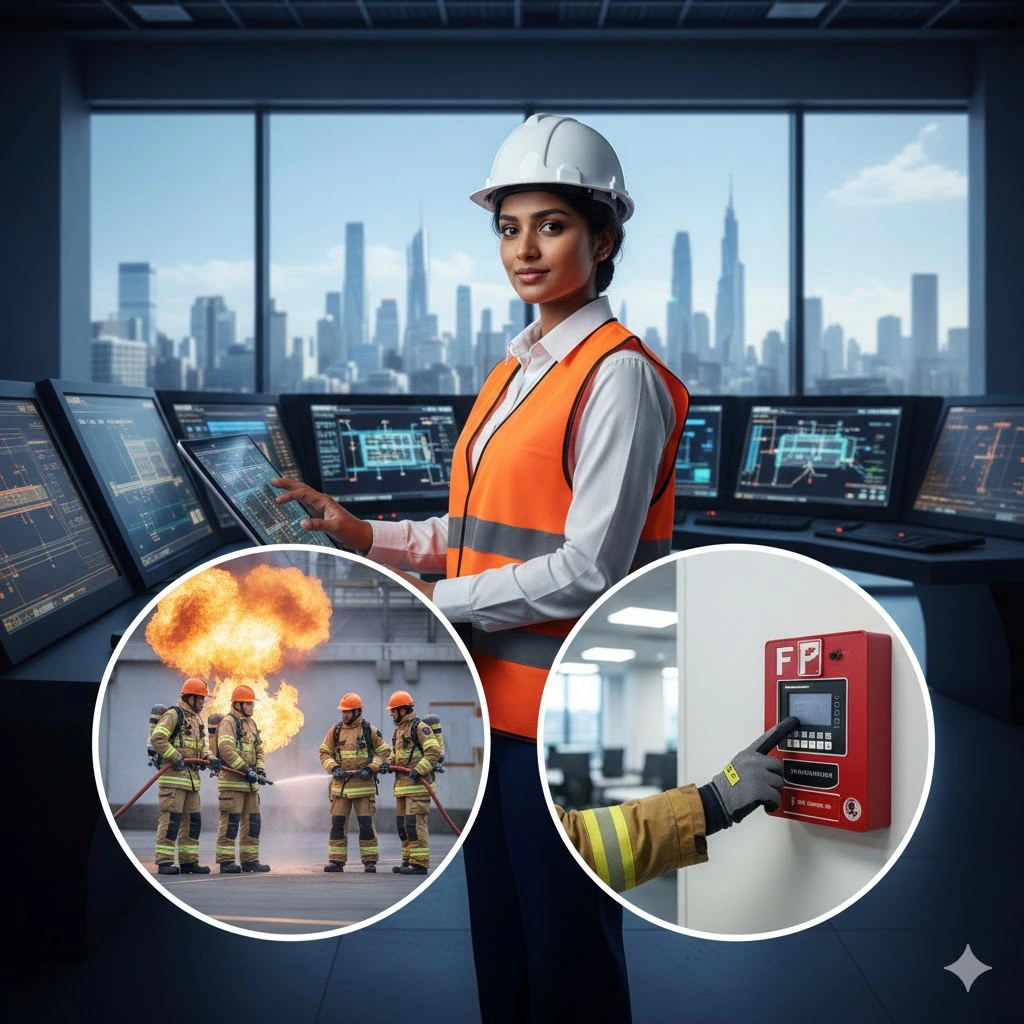
Graduates commonly work as:
- Fire Safety Officer
- Safety Supervisor
- HSE Officer
- Safety Engineer
- Fire Inspector
- Safety Auditor
- Disaster Management Executive.
After experience, they advance to senior safety management, consultancy or regulatory positions.
Bsc fire and safety course salary After Completion
Entry-Level
- ₹15,000 – ₹25,000 per month
With Experience (3–5 Years)
- ₹35,000 – ₹60,000 per month
Senior & Specialized Roles
- ₹8–12 LPA or more
Salary growth depends on:
- Industry sector
- Experience level
- Responsibility scope
- Additional certifications
How to Become a Fire Safety Officer?
One viable career opportunity is as follows:
- Complete B.Sc in Fire and Safety.
- Gain on-ground experience, training or industry.
- Apply to the safety officer positions.
- Upgrade competencies according to the industry requirements.
The qualification degree of this profession is a recognized degree.
Is Distance B.Sc in Fire and Safety Accepted?
Industries focus on:
- University recognition
- Exam validity
- Practical knowledge
- Compliance understanding
The secondary mode of study is the qualification legitimacy and competence. Online education using exams administered by the university is certainly valid as long as it is well organized.
Final Perspective
Fire and safety is not a job, it is a profession of responsibility which directly safeguards the lives, infrastructure and organizations. The B.Sc in Fire and Safety is unusual in terms of guaranteeing a secure job, social standing, low cost, and long-lasting significance.
This degree is a well-informed and future-proof option to students who are interested in a career that is practical, respected and stable.
Frequently Asked Questions
What is B.Sc in Fire Safety?
It is an undergraduate professional degree in fire prevention, industrial safety and risk management.
Which course is best in fire and safety?
An established B.Sc (Hons) in Fire and Safety provides the best long term basis.
What is the scope of fire and safety course?
Much so, because of the safety requirements that are compulsory to all industries.
What is the salary of a fire safety officer in India?
Normally between 15,000 and 60,000 per month, as per experience.
How can I become a fire safety officer?
By completing a recognized degree and getting real industry experience.